How to Build a Steel-Framed Deck for Ultimate Strength!
Steel-framed decks are becoming more common, especially where durability, straight lines, and long spans matter. Steel doesn’t rot, warp, or shrink like wood.
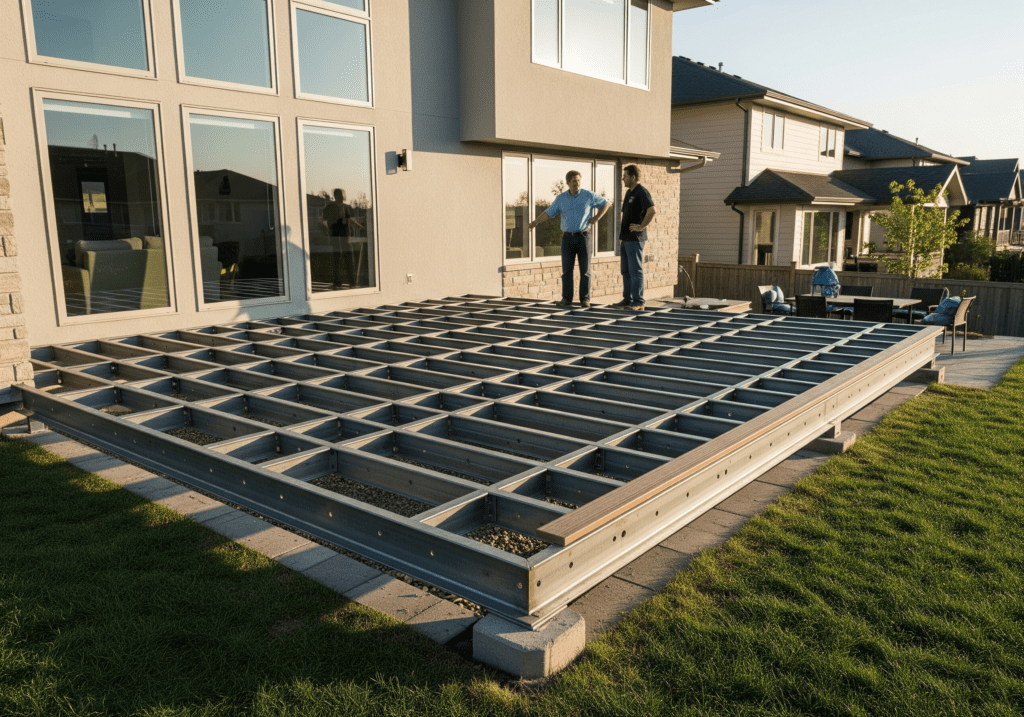
It stays square. It stays level. And when installed correctly, it provides a rock-solid foundation for almost any decking surface.
That said, building with steel is not the same as building with lumber. The layout, fastening, and sequencing all change.
This guide explains how to build a steel-framed deck correctly.
However, the structural principles covered in “How to Build an Elevated Deck,” “How to Build an Attached Deck,” and “How to Build a Composite Deck” are equally applicable here.
For actionable, location-based bill of materials, cost estimates, and a pro-level PDF, you need the DeckMaster AI. Click on the image below to get it!

Use this guide and Best Practices on How to Build a Deck to learn the fundamentals. Use DeckMaster AI to build “your” deck with confidence.
Table of Contents
What Is a Steel-Framed Deck?
A steel-framed deck utilizes cold-formed galvanized steel joists, beams, and tracks in place of pressure-treated lumber for its structure.
How Steel Framing Differs From Wood
Steel framing behaves very differently. Key differences include:
- No warping, twisting, or shrinking
- Higher strength-to-weight ratio
- Consistent dimensions
- No susceptibility to rot or insects
Steel requires precision, but it rewards accuracy.
When Steel Framing Makes Sense
Steel-framed decks are a good choice when:
- The deck is elevated or multi-level
- Long spans are required
- Straight lines and flatness matter
- Moisture or termites are a concern
Steel is often paired with composite, PVC, or hardwood decking.
Planning a Steel-Framed Deck
Steel decks succeed or fail in the planning phase.
Budget and Material Costs
Steel framing costs more upfront than wood. Plan for:
- Steel joists and beams
- Manufacturer-specific connectors
- Self-drilling fasteners
- Compatible decking fasteners
Labor may also be higher if the crew is unfamiliar with steel.
Design and Layout Precision
Steel does not forgive layout errors. Before ordering materials:
- Finalize deck dimensions
- Confirm joist spacing
- Plan seams, borders, and stair locations
Changes are harder once steel arrives.
How to Build a Steel-Framed Deck Structure
This is where steel shines.
Joist Spacing and Load Design
Steel joists are engineered components. Typical spacing includes:
- 16 inches on center for most decking
- 12 inches on center for diagonal layouts
Always follow the steel manufacturer’s load tables.
Leveling and Alignment
Steel stays straight, but the supports must be right. Pay close attention to:
- Footing heights
- Beam alignment
- Ledger elevation
A small error carries through the entire frame.
Attaching a Steel-Framed Deck to a House
Steel-framed decks can be attached or freestanding.
Ledger Board Options
Many steel systems use:
- A steel ledger track
- Or a traditional wood ledger with steel connections
Follow best practices from How to Build an Attached Deck for flashing and load transfer.
Flashing and Corrosion Control
Water management is still critical. Use:
- Proper flashing above the ledger
- Isolation between dissimilar metals
- Approved fasteners to prevent galvanic corrosion
Steel lasts longer when protected correctly.
Installing Decking Over Steel Framing
Steel works with many decking types.
Compatible Decking Materials
Steel frames commonly support:
- Composite decking
- PVC decking
- Hardwood decking
- Pressure-treated wood (with approved fasteners)
This flexibility is one of steel’s biggest advantages.
Fastening Deck Boards to Steel
Fastening methods differ from wood framing. Options include:
- Self-drilling screws
- Clip systems designed for steel
- Pre-punched steel joists
Never substitute wood fasteners on steel.
Steel-Framed Decks and Noise Control
Steel behaves differently underfoot.
Preventing Squeaks and Vibration
Good design reduces noise. Best practices include:
- Using isolation tape on joists
- Tight fastening patterns
- Proper blocking
A quiet deck feels solid and well-built.
Thermal Movement Considerations
Steel expands and contracts with temperature. Account for:
- Expansion gaps in decking
- Proper clip spacing
- Manufacturer installation temperature guidelines
Movement is predictable when planned for.
Railings and Stairs on Steel Frames
Safety systems still rely on solid attachment.
Railing Post Attachment
Rail posts must connect to structural steel. Options include:
- Welded brackets
- Bolt-on post bases
- Hybrid wood blocking attached to steel
Never rely on decking alone.
Stair Framing With Steel
Steel stair systems can be:
- Prefabricated steel stringers
- Hybrid steel-and-wood assemblies
Follow local code requirements closely.
Steel-Framed Decks in Different Applications
Steel adapts well to complex builds.
Elevated and Multi-Level Decks
Steel excels where height and span matter. It’s commonly used in:
- Elevated Decks
- Multi-level decks
- Decks on slopes
Strength and straightness reduce long-term issues.
Rooftop and Balcony Decks
Steel framing is ideal for:
- Rooftop decks
- Balcony decks
- Urban installations
Lightweight and predictability are major advantages.
Maintenance and Longevity
Steel framing reduces long-term headaches.
What Steel Eliminates
Steel removes many common problems:
- Rot
- Insect damage
- Warped framing
- Shrinking connections
The structure stays consistent over time.
What Still Needs Attention
You should still:
- Inspect fasteners periodically
- Check for coating damage
- Maintain the decking surface
Steel simplifies maintenance; it doesn’t eliminate responsibility.
Common Steel-Framed Deck Mistakes
Most issues come from unfamiliarity. Avoid:
- Mixing incompatible fasteners
- Ignoring manufacturer specs
- Poor footing alignment
- Skipping isolation materials
Steel demands accuracy, not shortcuts.
Final Thoughts
A steel-framed deck offers unmatched straightness, strength, and longevity. It costs more upfront, but it solves many of the long-term problems associated with wood framing.
When paired with composite, PVC, or hardwood decking, steel creates a stable platform that performs year after year.
By combining proven deck design principles from How to Build an Elevated Deck and How to Build an Attached Deck with steel-specific installation methods, you can build a deck that feels solid, looks clean, and holds up under real-world conditions.